Over the years, I’ve heard just about every argument against running research. Tight deadlines. Limited budget. Competing priorities. I’ve had to make the case for research more times than I can count, and I’ve found a few approaches that consistently help, which I’d like to share.
Why objections happen
It’s tempting to blame stakeholders when research gets cut from the plan. But in most cases, stakeholders aren’t “anti-research.” They’re juggling scarce time and money, and after design and development take their share, there’s often little left for anything else.
That doesn’t make objections any less frustrating, but it does give us a starting point. If we want research to get the space it deserves, we need to be ready with strong arguments for its value.
From notes to rebuttals
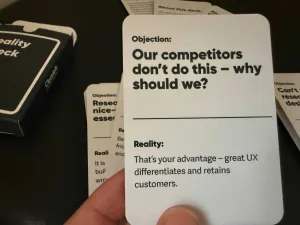
Over the years, I’ve built up a running list of “go-to” rebuttals for the most common objections. Eventually, I realised this list was too useful to sit hidden in my laptop, so I started turning it into something more practical - something other researchers could use too.
That idea became Reality Check: a deck of cards designed to help researchers respond to stakeholder objections.
Reality Check (the deck)
I collected 30 common objections and paired them with clear, effective rebuttals. Then, working with James and Frances, we turned this into a physical deck of cards, which can be used in two ways:
- In the moment: as a reference guide when you’re facing real stakeholder pushback.
- In practice: as a training tool in workshops, where you can role-play objections and sharpen your responses.
You’ll get a chance to use the cards if you join one of my upcoming workshops.
If you’d like to hear more about our Bridging the Gap workshops - or just want to stay in the loop about how we’re helping researchers build confidence in their practice - follow us on LinkedIn or get in touch with me directly.
Related thinking

- News
Reimagining the employee experience for LNER
- Viewpoint