Evidence-based understanding
The University of Manchester has a better understanding of the needs of its prospective students.
This is the story of how we used longitudinal research to help the University of Manchester uncover opportunities for improvement before, during, and after their open day.

More than 25,000 people registered for the University of Manchester’s open day this year. Those visitor numbers would rival a music festival, and attendees expect a top-notch personalised experience.
The university’s student recruitment team had mapped the open day user journey and identified some potential areas for improvement. What they needed next was an experienced third party to conduct user research to test their hypotheses and provide recommendations. As Manchester's strategic design partners, that’s where Clearleft came in… just in time to join this year’s final open day!
Clearleft did a great job in highlighting what we do well and where we can improve, with recommendations we’ll be implementing for our next round of open days.
We needed to talk to students before, during, and after the open day. We didn’t have much time to prepare for this kind of longitudinal research, but this wasn’t our first rodeo. We have a toolkit of tried and tested techniques that we could draw from and plenty of experience working with universities.
Our first step was to put together a research canvas to understand what was needed.
With just two weeks until the open day, we needed to recruit the right interview subjects straight away. Luckily for us, the University of Manchester team did a great job with that, making sure that we’d get to speak to people from under-represented groups.
In the run-up to the open day, we spoke to some prospective students over Zoom. For the open day itself, we made the journey to Manchester to interview people on site. We recorded all the interviews we did so that we could analyse the transcripts later.
As well as speaking to prospective students and their supporters (parents, friends, etc.), we undertook observational research, taking lots of pictures and documenting behaviours.
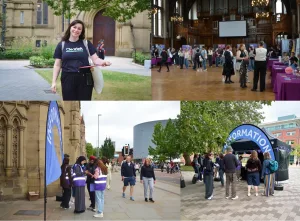
After the open day, we followed up with more Zoom interviews. The questions we asked were similar to the in-person interviews, but with the added benefit of time for reflection. What did they wish had been different? What worked? What didn’t? How was the follow-on communication?
Now that we had comprehensive data from before, during, and after the open day, we could analyse it all for insights.
The University of Manchester does a great job with their open day. Just managing the logistics of all those people in one place is seriously impressive! And attendees told us time and again how much they appreciated the human touch on the day. The team does a great job of conveying what life would be like as a student there.
That said, we found some underlying themes and highlighted several opportunities to the team. They spanned digital and physical touchpoints, running through the whole experience – before, during and after the open day. A key theme was that the open day experience could be more personalised. This isn’t just relevant to Manchester; most universities ask for a lot of information up front but then don’t use that data to tailor the open day to the individual.
There’s currently an app for the University of Manchester open day that only gets used on the day itself. There’s an opportunity to either ditch the app or find ways to make it more useful afterwards. That’s just one example of how the follow-on experience could potentially be improved.
The open day isn’t the finish line; enrollment is.
The University of Manchester is a world-class institution with an excellent open day. Thanks to the power of user research, they’re now in a position to make the whole experience even better.