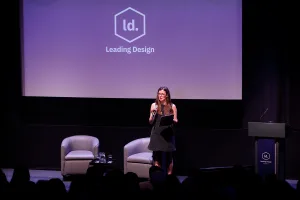
If I had to sum up the two days in three words, they’d be community, curiosity and care. Many people told me before the conference that they felt behind the curve. What became clear across the talks is that there isn’t a curve. There’s continuous momentum, moving faster than any of us can keep up with. What we can do is stay curious, get comfortable with the unknown, and keep experimenting together.
As I reflect on the incredible talks and conversations, here are a few standout takeaways…
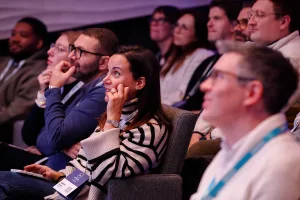
AI is now business as usual
Last year we dedicated a whole day to AI. This year, it simply ran through everything. AI is no longer a separate topic. It’s part of the landscape we operate in as design leaders.
Kwame Nyanning (Designer and Author at Agxncy Ltd.) set the scene on day one, with real-world stories about the speed and scale of change and the unknowns of leading in an agentic world. Marla Mitelman (Executive Director at Head of Design – Digital Enablement, J.P. Morgan) reminded us that the unusual isn’t unusual in itself. We’ve lived through hype bubbles before, and she gave us playful ways to ride them, even when everyone feels they can vibe code at the weekend.
Johanna Evans (VP Product Design at Guru) gave what might have been the most provocative talk of the conference, sharing how she gave parts of her job to the machines. It landed because it wasn’t about giving your whole role away. It was about choosing what to hand over, to free up time for the work that really delivers value as a leader.
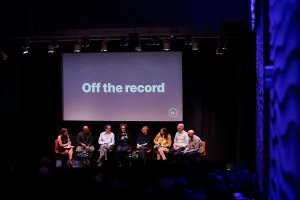
Curiosity is the skill we need most
Curiosity came up again and again as the most important skill for design leaders right now. Faced with the unknown, we can bury our heads in the sand, or we can stay hopeful, curious and experimental.
Liz Danzico (VP Design at Microsoft AI Experiences) shared lessons from Microsoft’s Royal Academy of AI, an experiment in helping teams explore AI in a playful but meaningful way, building community and levelling hierarchy so anyone can come and be curious. Michelle Lee (Partner + Managing Director at IDEO) closed the conference with a joyful talk that had us all playing games, and a timely reminder that while AI strips out friction, friction is where creativity comes from.
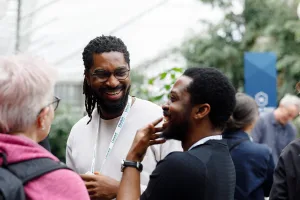
Move fast, with care
Sarah Deford Moser (Design Director at Slack) pushed back on the old adage “move fast and break things”. She showed that speed and intention can go together. When you’re clear on what you’re aiming for, and create the right conditions, your teams can stay curious and keep making magical products.
Kuba Bartwicki (Head of Design at Government Digital Service) showed that large, established organisations can do incredible, scalable creative work, and are often led by some of the most experimental design leaders around. The Immaculate Heart College Art Department Rules (commonly referred to as “Ten Rules”) gave us a brilliant set of prompts for challenging ourselves and creating change.
Earning trust at the top
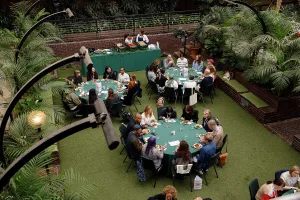
Executive sponsorship became a thread through many of the talks. Rich Rutter (Cofounder at Clearleft) shared findings from a global study, showing how executive sponsorship shapes a design team’s effectiveness. Dan Makoski (Chief Design Advisor at Uplifting Design) built on this, drawing on his experience with some of the world’s most ambitious CEOs to show how design leaders can earn trust and influence in a way that’s authentic to who they are.
Navigating the unknown with courage
Kevin Bethune (President at ImagineCo Studio) gave us a map through what he calls “the forest of ambiguity”, helping us find a clear direction even when the path ahead is uncertain. Aleksandra Melnikova (Founder at DRĄSA Studio), who brilliantly stepped in at the last minute, spoke about courage: the courage to hold space for the unknown, and to be vulnerable about what we don’t know. Drawing on frameworks from her recent studies at Harvard and her own experience, she finished by inviting us all to create our own courage monsters.
The quiet, human work of leadership
Much of the value of design leadership never shows up on a metrics sheet. Dominique Ward (Senior Director, Design Operations and Program Management at ServiceNow) explored this quiet craft, from how we cultivate our teams to the environments we create. Her murmuration metaphor showed how leadership can ripple through an organisation, far beyond our direct reach.
Soo Basu (Senior Director, Product Design at Adobe) spoke to the many design leaders facing big questions about their roles and careers, encouraging us to see ourselves not just as design leaders but as multifaceted people. Birgit Geiberger (Global Head of Product UX Design at IKEA) explored non-performative self-care, and how we can sustainably look after ourselves when we’re being pulled in so many directions.
Designing for a better world
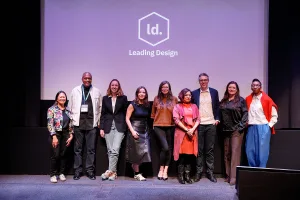
Ben Sheppard (Co-founder and Chair at Design for Good) gave us both a rallying cry and a practical toolkit. He invited us to join Design for Good’s mission to collaborate with global partners towards the UN Sustainable Development Goals, and shared ways to collaborate better and measure our impact in our own organisations.
Community and optimism
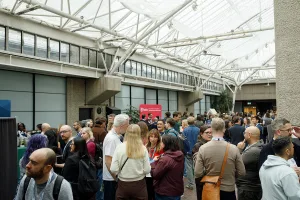
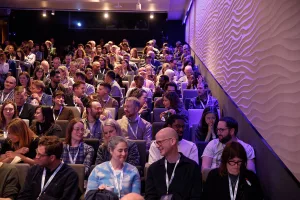
I think this year sold out because people are feeling isolated and unsure, and in those moments they come back to Leading Design for connection with the wider design community. As I said at the start of the conference, “what’s most personal is most universal”.
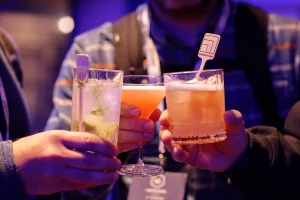
One of my favourite moments is always the drinks reception on the first night, when I get to hear how the ideas are landing. Coming into the conference, I asked everyone to hold space for optimism. Optimism isn’t naive. As creative problem solvers, I think it’s essential. It’s how we’ll create, innovate and navigate whatever the future holds.
See you next year!
If you couldn’t make it this year, you can sign up for Leading Design On Demand and catch up on this year’s talks, along with our extensive archive.
To make the most of being in the room with the brilliant Leading Design community, grab a super early-bird ticket for Leading Design London 2027 (10–11 November).
I’d love to see you there!