A map of what we’ve got now
The team now has a complete audit of their current site’s pages and components, complete with analytics.
This is the story of how we worked with Imperial Business School to plan a complete overhaul of their underlying platform so they can face the future with confidence.
Imperial Business School aims to attract post-graduate and MBA students. Their website is their shop window for showing the quality of their programmes. But this website uses a different Content Management System than the main Imperial College site.
It makes sense for Imperial Business School to migrate to the same CMS as Imperial College. It would save money and it would allow components and resources to be shared between them.
But this is a big website with thousands of pages, legacy content, and third-party integrations. A migration is going to be a huge challenge. It’s also an opportunity. Rather than do a lift-and-shift, Imperial Business School wants to make sure the new site is an improvement on their current one.
Rather than blindly rushing ahead, they realised that the best way to tackle this project was to take a step back and come up with a data-driven plan. That’s where Clearleft comes in.
We have a rare opportunity to transform our website. Clearleft helped us to explore possibilities, prioritise what we need to do, and create the roadmap for achieving our future website.
We started with a content audit of the site’s 3,337 pages, attaching performance metrics and analytics to each page. We grouped these pages into page types. Then we broke each page type down into its constituent components.
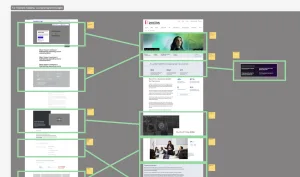
We did this by taking screenshots of page types and dissecting them in Figma, comparing them to matching page types on the Imperial College website to spot gaps and inconsistencies.
As well as documenting the functionality that needs to be migrated, we looked out for any opportunities to streamline third-party providers. We found multiple partners for videos and forms that could be consolidated.
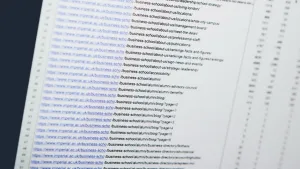
We also looked at search logs for clues as to what functionality might be missing from the current site.
At the same time as we were doing quantitative research of the existing website, we did qualitative research with stakeholders to find out what features they wanted for the site. We also ran an intercept survey with the site’s visitors.
We ran workshops with stakeholders to help them match up their wishlist with the data we were seeing from search logs. By getting people together, everyone got their chance to express different viewpoints, and ultimately agree on a shared vision for the upcoming change.
During these workshops they made decisions on what to keep and what to cut, backed up the data we brought them so that they could make these decisions objectively.
After going wide with the desk research and the stakeholder interviews, we filtered everything down into a report, listing initiatives that should be taken in order of importance. This report can be easily repurposed into a business case for the migration or a brief to send out to potential partners.
We made three versions of the report in three lengths; a one-page summary, a six-page briefing document, and the full multi-page in-depth report. The right length of report can go to the right person.
Before this project, the upcoming migration was intangible and scary. Now that the territory is mapped out, they’ve got a step-by-step route to take.
By providing them with data and insights, we helped them gain visibility so that they can explore the next phase with confidence.